Planning a composite deck starts with a simple question: How to calculate how many WPC boards I need for my deck? The answer depends on more than deck area. Board width, spacing, layout, and usable board length all affect the final count. Small measurement errors can leave a visible gap—or an awkward offcut.
Grand View Research reported that the global wood-plastic composites market was valued at about USD 7.7 billion in 2023, with growth projected through 2030. That market context points to rising interest in WPC, but it cannot replace a project-specific estimate. Measure the deck’s length and width, then check the manufacturer’s actual board dimensions and installation-gap guidance. A board’s nominal width may differ from its usable coverage once spacing is included.
Details matter. A 12-by-16-foot rectangle is easier to estimate than a deck with clipped corners, picture framing, or stairs. Count those features separately. Allow for cuts and defects, but avoid adding a random surplus. The right allowance depends on the pattern and site conditions. Even careful calculations can miss an unexpected trimming need; I would verify the layout with a scaled drawing before ordering. Measure twice. Then compare the estimate with the supplier’s board-length options and installation instructions.
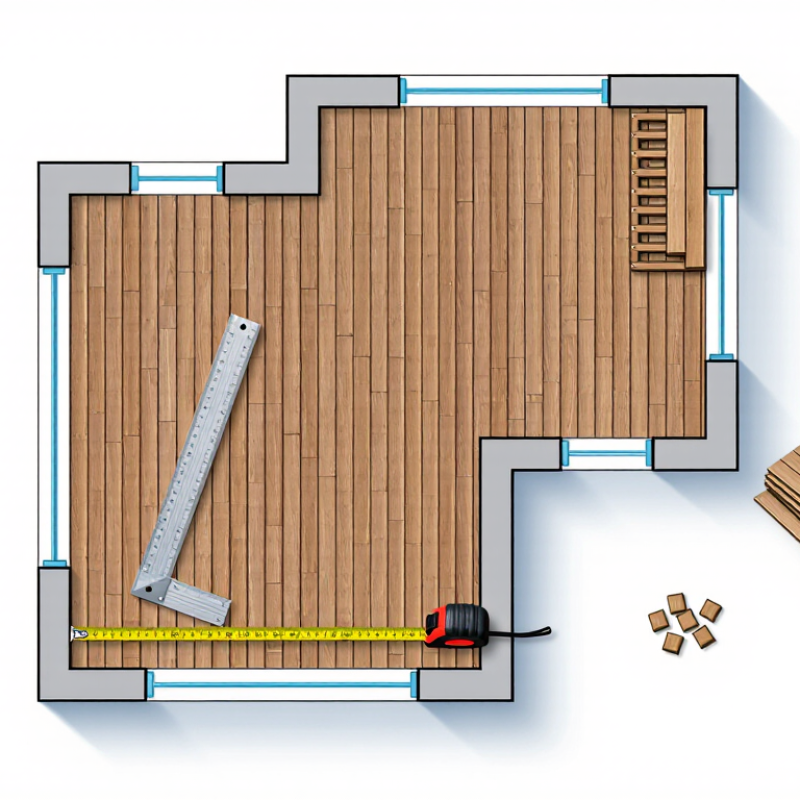
Start with the deck’s usable surface, not the number of boards you hope to buy. Measure the full length and width in feet, then multiply: a 16-foot by 12-foot rectangle covers 192 square feet. Keep it simple. Measure between the outer edges of the planned decking, and note where stairs, built-in benches, or cutouts change the footprint. Railings do not add deck surface.
For an L-shaped deck, split the plan into rectangles, calculate each one, then add the results. A rough sketch with dimensions helps catch small returns that are easy to overlook. Convert inches to feet before multiplying: 6 inches is 0.5 feet. Do not round each measurement too early; a few inches across a wide platform can shift the total. My first sketch might still miss an angled edge, so verify the dimensions on site.
The 2024 JLC Cost vs. Value report estimated a typical composite deck addition at $24,206 nationally. That is a project-cost benchmark, not a price per square foot, but it shows why a reliable footprint matters when requesting estimates.
After measuring, add a separate allowance for cuts and offcuts based on the layout and installer’s advice.
Before counting boards, find the installed coverage width, not just the nominal width. A board labeled 5.5 inches may cover less once its edge profile and installation gap are included. For example, 5.5 inches of coverage plus a 0.25-inch gap creates a 5.75-inch layout module. Across a 12-foot deck, that small difference can change the board count. Small differences add up.
Check the product’s current installation guide for usable width, available lengths, and the required gap at the expected installation temperature. ASTM D7032-21 evaluates wood-plastic composite decking performance, but it does not prescribe one universal board width or spacing. Those dimensions are product-specific. The USDA Forest Products Laboratory’s Wood Handbook documents how moisture affects solid wood dimensions; do not assume WPC boards respond identically. Use the WPC manufacturer’s own expansion and spacing data instead. That number matters.
Measure the deck’s clear span, then divide by the board-and-gap module. A 144-inch span divided by a 5.75-inch module needs 25.04 rows, so plan for 26 before accounting for edge cuts. Check whether the stated board length includes usable end coverage, too. I would recheck the specification sheet against the installation guide; details can differ between documents, and that is easy to miss.
Confirm usable board width, length, and gaps in the manufacturer’s specifications.
Example planning scenario: a 4,000 mm-wide deck uses boards spanning its 3,600 mm length, with a 5 mm gap between boards. The estimated number of boards across the deck is 28 at 140 mm usable width, 27 at 145 mm, or 26 at 150 mm. These are example measurements; use the usable coverage and board length specified for your product. The calculation allows for gaps between boards and does not include cutting waste.
For a 5.5-inch WPC board with a 3/16-inch gap, each installed row covers about 5.6875 inches. The gap matters. Divide 12 inches by 5.6875 to estimate roughly 2.11 linear feet of board per square foot of deck. For a 12-by-16-foot area, that means about 405 linear feet before waste. Check the board’s actual face width, since nominal dimensions can differ from usable coverage.
Add around 5 to 10 percent for cuts and offcuts; a diagonal pattern or many corners may need more. With a 10 percent allowance, the example needs about 446 linear feet. If boards are 12 feet long, divide 446 by 12 and round up: plan for 38 boards. Measure the deck in the direction the boards will run, and account separately for borders or picture-frame edges. Measure twice. This is a planning estimate, not a perfect count; I would recheck the layout before ordering, especially where the last row may need trimming.
Divide Deck Area by Board Coverage and Adjust for Board Direction
Start with the deck’s usable area, then calculate each board’s effective coverage. For a board running 12 feet long and 5.5 inches wide, include the planned gap between boards. With a 1/4-inch gap, its effective coverage is about 0.48 square feet. Divide the deck area by that figure, then round up. Check the board’s actual dimensions; nominal sizes can differ from measured sizes. Small details matter.
Direction changes the count. Run boards across a 12-by-16-foot deck, and each row spans roughly 12 feet; turn them, and rows span 16 feet. This affects board lengths, end joints, and offcuts, even when deck area stays constant. For a cleaner estimate, calculate rows from the deck dimension perpendicular to the boards, using board width plus gap. Add a practical cut allowance, often 5–10%, for edges, obstacles, and unusable offcuts. It is not universal. I still recheck corners by hand. The U.S. EPA’s 2020 report, Advancing Sustainable Materials Management: 2018 Fact Sheet, estimates 600 million tons of construction and demolition debris were generated in 2018. That figure covers all such debris, not decking, but it underscores why careful measurement and realistic ordering matter.
A 5–10% cutting allowance helps cover offcuts, damaged edges, and awkward end joints. Calculate the board count from usable coverage, not nominal width. For a 12-by-16-foot deck using boards with 5.5 inches of effective coverage, 12 feet across requires about 27 courses. Add 5% and round up: order 29 boards. At 10%, order 30, assuming each board spans the full 16-foot length.
Measure twice. Check the layout. Staggered joints, picture-frame borders, and angled edges can increase offcuts, so the lower allowance may be too tight. A simple rectangle with few cuts may need less waste than a deck around posts or steps. The US EPA’s 2018 construction and demolition debris report estimated 600 million tons of such debris in the United States, with most coming from demolition. That figure is not a WPC cutting recommendation, but it highlights why careful estimating matters. Keep spare boards from the same batch if possible; color and surface texture can vary between production runs.
Before ordering, confirm the board’s actual coverage and the supplier’s recommended gap. I’d revisit the estimate after marking the layout on site. Plans miss things. A single border can change the count.
Measure the usable length and width in feet, then multiply them. A 16-by-12-foot deck covers 192 square feet.
Divide the plan into rectangles, calculate each area, and add them together. A rough sketch can reveal small returns you might overlook.
Measure the planned decking surface, including relevant cutouts and built-in areas. Railings do not add deck surface; measure stairs separately if they need boards.
Nominal width may differ from installed coverage. A 5.5-inch board with a 0.25-inch gap uses a 5.75-inch layout module.
Divide 144 inches by the board-and-gap module. With a 5.75-inch module, plan for 26 rows before edge cuts.
With 5.5-inch boards and 3/16-inch gaps, estimate about 405 linear feet before waste. Small differences add up.
Add roughly 5 to 10 percent for cuts and offcuts. Diagonal layouts and many corners may need more.
With a 10 percent allowance, 446 linear feet divided by 12 means 38 boards. Recheck the final layout; I might miss a trimmed edge.
To determine How to calculate how many WPC boards I need for my deck, first measure the deck’s length and width in feet and multiply them to find its total area. Then check the manufacturer’s specifications for each board’s usable width and length, along with the recommended spacing between boards. For example, a 5.5-inch-wide board installed with a 3/16-inch gap covers a little more than its face width, so include the gap when estimating how much deck area each board will cover.
Divide the deck area by the coverage provided by one board, taking into account the direction the boards will run and how their lengths fit the deck. Finally, add a 5–10% allowance for cuts, edges, and possible mistakes, then round up to a whole number of boards. These steps provide a practical estimate and help reduce the chance of running short during installation.

KandS Floor