How to Choose Eco Friendly Recyclable WPC Flooring in 2026?

Time:2026-11-01 Author:Aria
0%

In 2026, choosing WPC flooring means looking beyond a “green” label. Is WPC flooring environmentally friendly and recyclable? The honest answer depends on its materials, manufacturing, service life, and end-of-life options. Wood-plastic composite flooring may use recycled wood or plastic, but that alone does not prove a lower environmental impact. Check the product’s technical data, recycled-content claims, and independent environmental documentation. Look closely at the wear layer, core, and attached underlay. A sample in your hand can reveal how many layers must be separated.

William McDonough, an architect and circular-design advocate, is associated with the principle, “Waste equals food.” It offers a useful lens, not a guarantee that every WPC plank can be recycled. Ask the supplier who accepts the flooring after removal, whether collection is available in your area, and what happens to mixed materials. Get the answer in writing. If no take-back route exists, recyclability may be theoretical for your project. Also compare expected lifespan and maintenance needs; replacing a short-lived floor creates more material to manage. Some details are easy to miss. This guide explores how to assess WPC flooring in 2026 using practical evidence, clear questions, and a little healthy skepticism. A perfect product may not exist, but a well-documented choice is easier to defend.
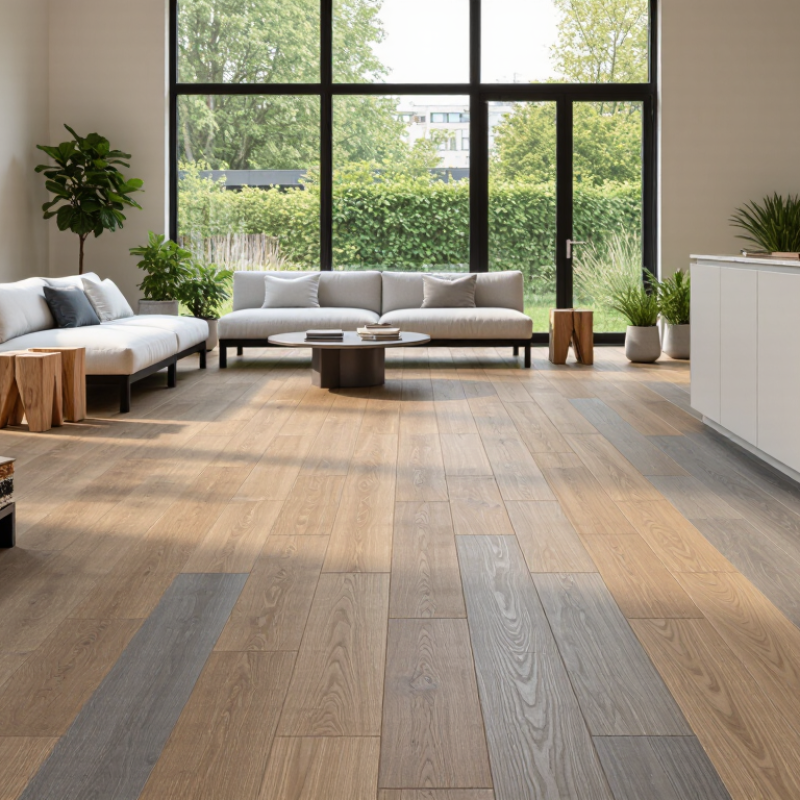
How to Choose Eco Friendly Recyclable WPC Flooring in 2026?

Define WPC Flooring: Compare PVC, PE, and PP Core Materials

WPC flooring combines wood flour or fibers with a thermoplastic polymer, but “WPC” does not identify one standard recipe. PVC cores are dimensionally stable and resist moisture, yet chlorine-containing PVC and mixed additives can complicate recycling. PE cores often feel slightly more flexible and tolerate impacts; PP cores are lighter and generally handle heat better. Actual performance depends on formulation, core density, and wear-layer construction. That matters.

PlasticsEurope’s Plastics—The Fast Facts 2024 reports 413.8 million tonnes of global plastics production in 2023, with post-consumer recycled plastics representing 8.7% of production. This wider industry figure is not a WPC recycling rate. It does show why “recyclable” needs a clear explanation. Ask whether the product uses PVC, PE, or PP, and whether the flooring can be collected and processed in your region. A recyclable polymer alone does not guarantee a recycling route.

Tips: Check the technical sheet for polymer type, recycled content, and take-back options. Look for a declared test standard and ask how wood fibers, adhesives, and surface layers affect sorting. Compare real samples underfoot. Some details may still be unclear; suppliers should state that plainly rather than promise effortless recycling.

Verify Recycled Content Claims Under ISO 14021

How to Choose Eco Friendly Recyclable WPC Flooring in 2026?
Verify Recycled Content Claims Under ISO 14021

A recycled-content claim on WPC flooring needs evidence, not just a green label. ISO 14021:2016 sets requirements for self-declared environmental claims, including recycled-content statements. It is not a product certification. Ask for the percentage by product weight, with pre-consumer and post-consumer material reported separately. The standard excludes manufacturing scraps that can be reused in the same process from pre-consumer recycled content. Small wording differences matter.

Request supplier declarations, calculation sheets, and batch-linked purchasing or production records. Check that figures cover the finished flooring, not only one ingredient. A lab test may confirm material composition, but usually cannot prove whether plastic was previously used. Paperwork can look tidy. Verify the trail.

The scale of waste makes careful claims relevant. UNEP’s Global Waste Management Outlook 2024 estimates that global municipal solid waste reached 2.1 billion tonnes in 2023 and could reach 3.8 billion tonnes by 2050. That figure is not specific to WPC, but it shows why clear material accounting matters. Compare documents against the exact product and production batch you plan to buy. If the supplier cannot explain the calculation or source records, treat the percentage as unverified—not as proof of better environmental performance.

How to Choose Eco-Friendly Recyclable WPC Flooring in 2026? — Verify Recycled Content Claims Under ISO 14021

Illustrative example only—not a real product claim: In this hypothetical 100 kg batch, 18 kg is post-consumer recycled material and 12 kg is pre-consumer recycled material, giving 30% recycled content by mass. ISO 14021 provides guidance for substantiating self-declared environmental claims; it does not set a minimum recycled-content percentage or certify a product. Ask suppliers for product-specific evidence, such as material records and traceable mass-balance documentation, and check how the claim defines its recycled inputs.

Check VOC Emissions: FloorScore Sets a 0.5 mg/m³ TVOC Limit

When comparing WPC flooring in 2026, look beyond “low-VOC” wording. FloorScore sets a 0.5 mg/m³ limit for total volatile organic compounds (TVOC) in its emissions testing. TVOC measures a group of airborne chemicals released by materials. The figure refers to test conditions, not the expected concentration in every home. Details matter. Ask for the current test report and confirm it covers the exact flooring product you plan to buy. A similar product name may not mean an identical construction.

Check the report’s date, testing method, and product description. Also consider the complete floor assembly: underlay, adhesive, and cleaning products can affect indoor air quality. Keep the room ventilated during installation and follow the maker’s care instructions. A lower TVOC result is useful, but it does not prove a floor is harmless or recyclable. WPC layers can combine wood fiber, plastic, and additives, which may complicate recycling in your area. Ask what materials the floor contains and whether a local collection program accepts them. I would not treat a recycling symbol alone as proof that the product will actually be recycled.

Compare Wear Layers: 0.3, 0.5, and 0.7 mm Are Common Options

How to Choose Eco Friendly Recyclable WPC Flooring in 2026?

The wear layer is the clear protective coating above a WPC floor’s printed design. Common options are 0.3, 0.5, and 0.7 mm. A 0.3 mm layer may suit bedrooms or lightly used spaces. For busy family areas, 0.5 mm can offer a more practical balance. A 0.7 mm layer may be worth considering for heavier traffic, but thickness alone does not guarantee durability. Check the product’s abrasion ratings, finish details, and warranty conditions. Small print matters.

Tips: Match the layer to real use. Picture sandy shoes near the entry, rolling chairs, and a dog turning sharply on the floor. Ask for a sample and inspect its coating under bright light. Compare specifications, not just thickness. A thicker layer may cost more without solving every wear problem.

For an eco-conscious choice, ask what the wear layer and core contain, and whether the flooring has a documented recycling or take-back route. WPC products can combine different materials, so “recyclable” does not always mean your local facility accepts them. Request clear material information. I would not judge environmental performance from the wear layer number alone; it is an easy detail to focus on, but only one part of the decision.

Confirm Local Recycling Routes Before Choosing a WPC Floor

Before choosing a WPC floor, check where it can go after use. “Recyclable” on a product sheet does not guarantee that a local facility accepts it. Call your municipal waste service and nearby construction-material recovery centers. Ask specifically about wood-plastic composite flooring, not just plastic or timber.

Get practical details. Will they accept boards with attached underlay, coatings, or clips? Must the flooring be clean and separated by material? Some facilities may refuse mixed composites because wood fibers and plastic are difficult to process together. Keep the answer in writing if possible. A quick phone call helps, but rules and services can change.

Also ask the installer how the floor can be removed without breaking it into tiny pieces. Save the product specification and installation details; they may help a future recycler identify the material. If no local route exists, ask whether the supplier offers a take-back option, and check the transport distance. A distant recycling route may use more resources than expected. It is tempting to treat a recycling symbol as a complete plan. It isn’t. Local capacity matters, and sometimes the honest answer is that disposal options remain limited.

FAQS

What evidence should support a recycled-content claim for WPC flooring?

Ask for supplier declarations, calculation sheets, and records linked to the production batch. Paperwork can still look neat and be wrong.

How should recycled content be reported?

Request the percentage by finished product weight. Pre-consumer and post-consumer materials should be listed separately.

Does ISO 14021:2016 certify a WPC floor?

No. It sets requirements for self-declared environmental claims, including recycled-content statements. It is not product certification.

Can a laboratory test prove the plastic was recycled?

Usually not. A test may identify material composition, but it generally cannot show whether plastic was previously used.

Does a “recyclable” label mean my local facility will accept the flooring?

No. Call local waste services or recovery centers and ask about WPC flooring specifically. Get the answer in writing, if possible.

What details should I check with a recycling facility?

Ask whether it accepts boards with underlay, coatings, or clips. Some facilities require clean flooring separated by material. Not every center accepts composites.

How can I make future removal easier?

Ask the installer how to remove boards without breaking them into tiny pieces. Save the product specification and installation details.

What if there is no nearby recycling route?

Ask about supplier take-back and check transport distance. A distant option may use more resources than expected. Local choices can be limited.

Conclusion

Choosing an eco-friendly, recyclable WPC floor in 2026 starts with understanding its core material. WPC combines wood-based material with a polymer, commonly PVC, PE, or PP; compare these options for durability, composition, and the recycling facilities available in your area. Ask suppliers for clear evidence of recycled-content claims and check that documentation follows ISO 14021 principles rather than relying on vague environmental wording.

Also compare indoor-air emissions and wear-layer thickness. Look for test results showing TVOC emissions against the 0.5 mg/m³ benchmark, and consider common wear layers of 0.3, 0.5, or 0.7 mm according to expected use. Is WPC flooring environmentally friendly and recyclable depends not only on its materials but also on verified claims, product performance, and whether a local collection or recycling route can actually accept it. Confirm disposal options before choosing, since recyclability can vary by product and location.

Aria

Aria

Aria is a dedicated marketing professional with a deep passion for innovative strategies and a keen understanding of our company's product offerings. With a wealth of experience in the industry, Aria excels at crafting engaging content that highlights the unique features and benefits of our......