Can WPC decking be used in saltwater environments? In many cases, yes, but suitability depends on the board’s composition, installation, and exposure. Wood-plastic composite combines wood fibers with polymers, so it does not rust like unprotected steel. Yet saltwater settings still bring challenges. Salt spray can leave a gritty film, while strong sun, heat, and repeated wetting can gradually affect the surface. No board is immune to wear.
Picture a deck beside a tidal pool: salty droplets dry on the boards, sand gathers near the steps, and water lingers around poorly drained supports. These small conditions matter. Choose products whose manufacturer specifies use in coastal or marine-adjacent areas, and check the warranty carefully; “water-resistant” does not always mean suitable for constant salt exposure. Use corrosion-resistant fasteners recommended for the system, allow water to drain, and avoid trapping debris between boards. A gentle freshwater rinse can remove salt and grit. Simple, but useful.
The material itself is only part of the decision. Board quality, framing, ventilation, and installation details all influence long-term performance. Even a well-made deck may fade, stain, or develop surface wear over time, especially under intense sunlight. That is easy to overlook when comparing samples indoors. This article explains how WPC responds to saltwater, what features to check before buying, and which maintenance habits help preserve its appearance. The practical answer is encouraging, but not absolute: coastal performance depends on the whole deck system, not just the boards.
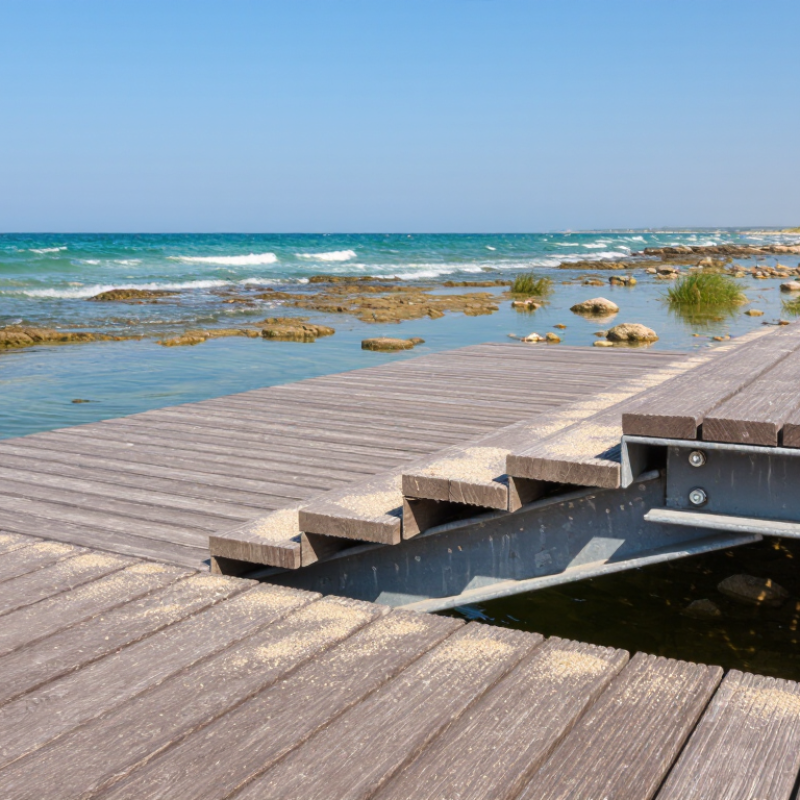
WPC decking combines wood fibers or fine wood flour with thermoplastic polymers and processing additives. The wood gives the board a textured, familiar appearance. The polymer binds the particles into a dense profile. Stabilizers and pigments help manage weathering and color changes. The exact recipe varies, so performance should be checked against the product’s technical data, not assumed from appearance alone.
Its structure matters near saltwater. A well-formed board has fewer exposed pathways for water than untreated timber, so salt is less likely to soak deeply into the material. That can reduce swelling, splintering, and decay. Small gaps matter. Boards still need room to drain and dry, especially around edges and beneath the deck. Salt can collect on surfaces and metal fixings, while cut ends may expose more wood content. Rinsing and checking fasteners are sensible upkeep. The material is not magic, and that distinction is easy to overlook. WPC resists many moisture-related problems, but standing water, poor installation, or neglected hardware can still shorten a deck’s service life.
| Component or Structural Feature | Typical Material or Construction | Relevance in Saltwater Environments | Practical Consideration |
|---|---|---|---|
| Wood fiber or wood flour | Ground wood fibers or flour are blended with a thermoplastic polymer. The proportions vary by formulation. | Wood content can absorb moisture, so WPC is not completely waterproof. The surrounding polymer matrix can limit direct exposure compared with unprotected wood. | Choose a product rated for outdoor use and follow its installation and maintenance instructions. |
| Thermoplastic matrix | Common matrices include polyethylene (such as HDPE), polypropylene, or PVC. The polymer surrounds and binds the wood particles. | These polymers do not rust through electrochemical corrosion in the way ordinary steel can, making the decking material suitable for many wet, coastal settings. | Resistance to saltwater, moisture, and chemicals depends on the specific polymer and product formulation. |
| Additives and pigments | Formulations may include colorants, processing aids, UV stabilizers, and other additives. | Some additives help with color retention or weathering, but they do not make every WPC product equally resistant to sun, moisture, or salt exposure. | Review the product’s published outdoor-use guidance rather than assuming all WPC has the same performance. |
| Extruded composite profile | Deck boards are commonly formed by extrusion. Profiles may be solid or contain hollow chambers, depending on the design. | The profile itself does not rely on a metal substrate that can rust when exposed to saltwater. Hollow areas and cut ends can still collect water if detailing is poor. | Provide appropriate spacing, drainage, ventilation, and end details in accordance with the installation instructions. |
| Capped or uncapped surface | Some boards have a polymer-rich outer layer formed over a WPC core; other boards have an exposed composite surface. | A cap can reduce direct contact between the core and surface moisture, but it does not eliminate the need for drainage or make the board impervious to all conditions. | Check how the product handles cut ends, edges, and fastener penetrations, especially in frequently wet areas. |
| Fasteners and substructure | Decking is attached to a supporting frame with compatible screws or clips; the support structure may be wood, composite, or metal. | Saltwater can accelerate corrosion of unsuitable metal fasteners and components even when the WPC boards themselves do not rust. | Use fasteners and structural materials specified for the exposure conditions and compatible with the decking system. |
| Overall exposure performance | Performance depends on the recipe, board design, installation details, exposure, and ongoing care; there is no single composition shared by all WPC decking. | WPC can be used in many coastal and saltwater-adjacent settings, but saltwater suitability should not be treated as a guarantee of marine-grade performance. | Rinse off salt deposits as appropriate, keep drainage paths clear, and follow the manufacturer’s guidance for the specific product. |
Note: WPC formulations and performance vary. Consult product documentation and local requirements for the intended exposure and installation.
Salt can stay in board gaps after surfaces look dry. It may corrode bare steel, while damp timber can swell, crack, or decay. Concrete can also be affected if chloride reaches embedded steel.
No. WPC can avoid some timber problems, but it may still stain or wear. Poor installation can trap salty water beneath a loose board.
Use a firm, well-drained substructure and keep the underside ventilated. A slight slope away from walls helps water escape. Keep gaps clear.
Follow the decking system’s installation guide. Boards can move as temperatures change, so guessing the spacing may cause problems.
Choose corrosion-resistant screws and connectors specified for marine exposure. Avoid mixing metals that may corrode when damp. Small details matter.
Rinse with fresh water every few weeks, especially after heavy spray or windy weather. A soft brush can loosen gritty patches.
Look for loose fixings, fading, swollen areas, damaged edges, and blocked gaps. Check shaded areas too. I once missed debris there.
Avoid aggressive pressure washing unless the product instructions allow it. A gentle rinse is often enough. Not always, though.
There is no reliable fixed lifespan. Board composition, exposure, drainage, installation, and maintenance all affect how long it lasts.
Can WPC decking be used in saltwater environments? In many cases, yes. WPC decking combines wood fibers with plastic polymers, creating a material that can be more resistant to moisture and decay than untreated wood. Saltwater can accelerate corrosion in metal components, dry out or damage some materials, and contribute to staining or deterioration. WPC does not eliminate every coastal-decking concern, but its composition can help it tolerate frequent humidity and splashes when the product is designed for outdoor use.
Successful performance also depends on installation and care. Allow for proper drainage, airflow, and expansion, and use corrosion-resistant fasteners suitable for coastal conditions. Regularly rinse away salt deposits and remove dirt or debris, while checking the deck and fixings for wear. With appropriate installation and routine maintenance, WPC decking can provide a durable, low-maintenance option in saltwater settings, though its lifespan will vary with exposure, product quality, and upkeep.

 KandS Floor